
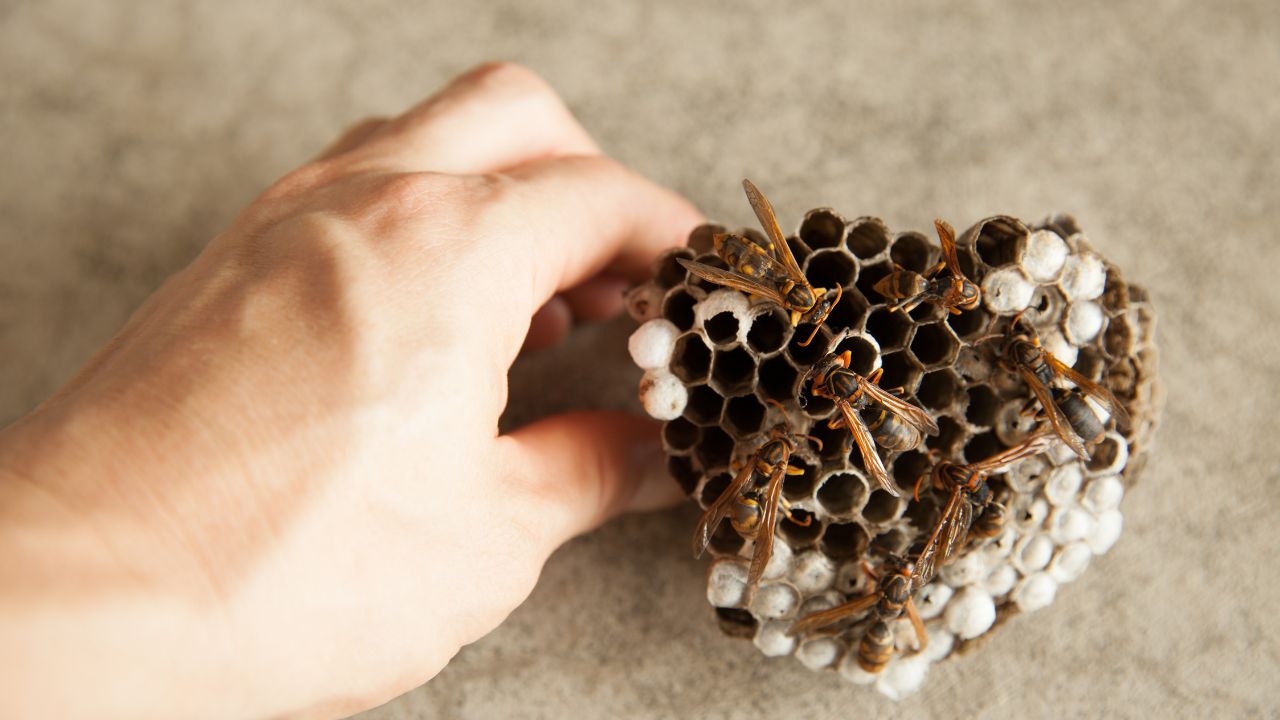
There is a moment every summer when a wasp nest stops being background noise and becomes a problem. Usually it is the moment someone gets stung near the back door, or you notice the traffic pattern and realize how many are coming and going.
The instinct is to grab a can of spray and sort it out that evening. Sometimes that works. Often it goes badly, and the reasons it goes badly are worth understanding before you are up a ladder in the dark.
Not every nest needs the same approach, and not everything that looks like a wasp is one.
Paper wasps build an open, upside-down umbrella of cells with no outer covering. You can see straight into it. These usually hang under eaves, deck railings, patio furniture and inside barbecue lids. Paper wasps are the least aggressive of the group and will generally leave you alone unless you get within a metre or so of the nest.
Yellowjackets build fully enclosed papery nests with a small entry hole. The nest itself is often hidden, inside a wall void, under a shed, in an attic, or underground in an old rodent burrow. Frequently all you see is a steady stream of wasps disappearing into a gap in the siding. Yellowjackets are aggressive, they sting repeatedly, and they are the species responsible for most stings in the Fraser Valley.
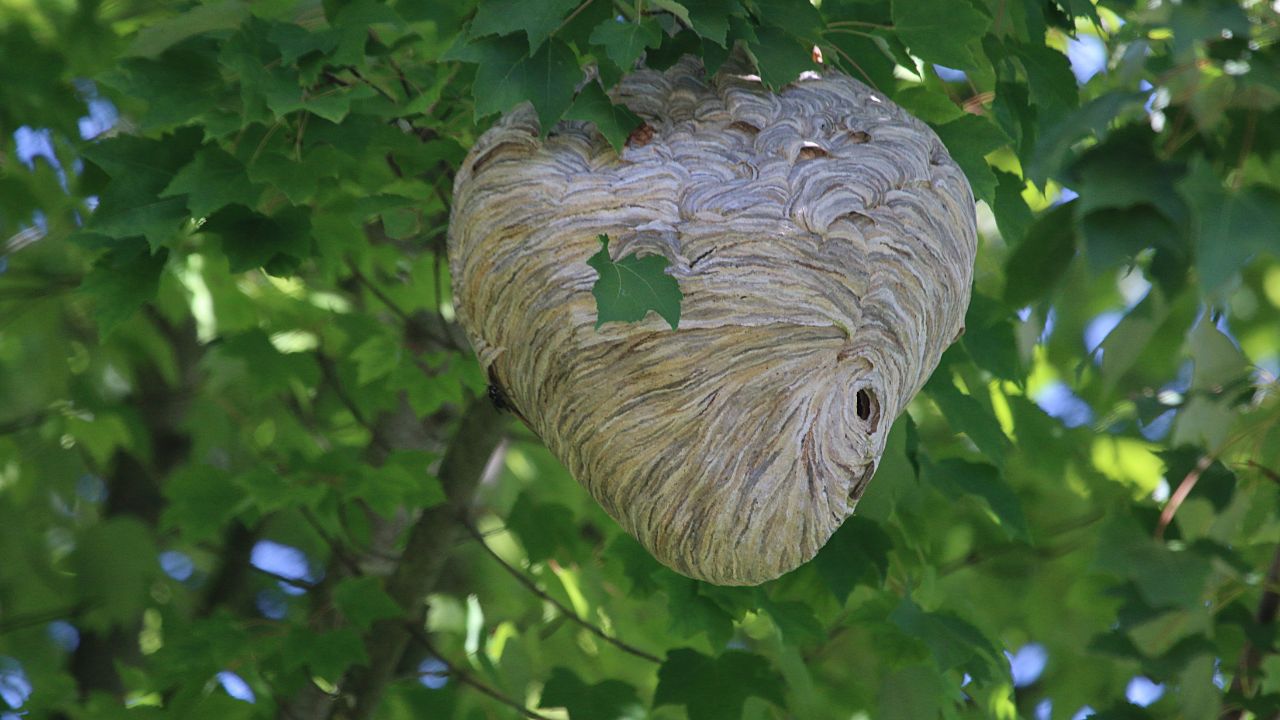
Bald-faced hornets build the large grey football-shaped nests that hang from tree branches and eaves. These are technically a yellowjacket, and they are the most defensive of the lot. They will pursue a perceived threat well away from the nest.
Honeybees and bumblebees are not wasps and should not be treated as pests. Honeybees are furry, golden brown, and swarm in a dense cluster rather than a papery nest. If you have a honeybee swarm, a local beekeeper will usually collect it for free. Bumblebees nest in small numbers in ground cavities and rarely bother anyone. Both are pollinators worth protecting.
One thing you can stop worrying about: it is not a giant hornet. Those turned up in BC in 2019 and prompted a lot of headlines, but the province declared BC free of them following the eradication announcement in late 2024. They also nested in the ground in forested areas rather than in buildings.
A wasp colony follows the same arc every year, and where you catch it determines how difficult removal is.
A single queen starts the nest in spring, building a structure about the size of a golf ball and raising the first workers herself. Through June and July the colony grows steadily. By late August and September a mature yellowjacket nest can hold several thousand wasps.
Late summer is also when they become noticeably more aggressive. The colony stops raising brood, the workers switch from hunting protein to seeking sugar, and they turn up at your picnic table with an attitude. This is exactly when most people finally decide to deal with the nest, which is the hardest possible time to do it.
If you spot a nest in May or June, dealing with it then is dramatically easier and safer. A nest the size of a golf ball holds a handful of wasps. The same nest in September holds a small city.
The colony dies off with the first hard frost, and wasps do not reuse an old nest the following year. That is worth knowing, because a visible nest in November is not a problem that needs solving.
Plenty of people remove a small paper wasp nest successfully. The trouble is that the situations where DIY fails are the ones most likely to hurt someone.
Ladders and stings do not mix. A large share of serious wasp injuries are not from venom, they are from falling. Getting stung while holding a can of aerosol at the top of a ladder produces a predictable outcome. If the nest is above head height, that alone is reason enough to call someone.
Spraying a wall void makes things worse. This is the mistake we get called out to fix most often. A nest inside a wall or soffit has an exit to the outside, but it also has the interior of your home on the other side. Spray into the entry hole and the colony frequently escapes inward, through light fixtures, outlets and ceiling gaps, into the room below. What was an outdoor problem becomes an indoor one.
Aerosol range is optimistic. A can rated for six metres delivers that in still air, on a full can, aimed perfectly. Real conditions cut it substantially, and a stream that falls short simply announces your presence.
Killing the outside layer does not kill the nest. Wasps you can see are a fraction of the colony. The rest are inside, and the queen is deep in the centre. Foragers return over the following days, and if the queen survives the colony rebuilds.
Underground nests are unpredictable. You cannot see the size or the shape, and there is often more than one exit. Pouring anything into the hole tends to produce a very fast response from a direction you were not watching.
Allergies are the real risk. Most people get a painful lump. Some get anaphylaxis, and plenty of them had no idea they were allergic, because a first sting can sensitise and a later one triggers the reaction. If anyone in the household has a known sting allergy, DIY removal is not a reasonable risk to take.
.jpg)
Get emergency help immediately if you see swelling of the face, lips, tongue or throat, difficulty breathing or swallowing, dizziness or fainting, widespread hives away from the sting site, or a rapid weak pulse. Call 911. If an epinephrine auto-injector is available, use it and still call, because symptoms can return.
Multiple stings from a disturbed nest warrant medical attention even without an allergy, because the venom load itself becomes a problem.
The difference is not bravery, it is method and equipment.
A technician identifies the species first, since the treatment for a paper wasp nest under an eave has little in common with a yellowjacket colony in a wall cavity. Proper protective gear means being able to work steadily rather than flinching. Wall voids get treated with an insecticidal dust rather than a spray, because dust carries through the void to reach the nest itself and the returning wasps track it inward instead of escaping into the house.
The nest is then physically removed where it can be reached. This part gets skipped in DIY attempts, and it matters. An abandoned nest full of dead brood attracts carpet beetles and other secondary pests, and in a wall it can hold moisture and cause staining.
Finally, the entry point gets sealed. Wasps favour a location for a reason, and a gap that suited one queen will suit the next one in the spring.
Walk the property in April and May and look for early nests. A golf-ball nest comes down in seconds with no drama at all.
Seal gaps in siding, soffits and around vents before spring. Keep bins closed and rinse recycling, since sugary residue is a strong attractant in late summer. Check spots people forget, barbecue lids, patio umbrellas, playhouse roofs and the underside of deck railings. Fill in old rodent burrows in the lawn, which are prime real estate for ground-nesting yellowjackets. Move compost and fallen fruit away from doors and seating areas.
.jpg)
Call someone if the nest is inside a wall, attic or soffit, if it is higher than you can safely reach from the ground, if it is near a doorway, walkway or play area, if it is a bald-faced hornet nest, if anyone in the household has a sting allergy, or if you have already sprayed it and the wasps are still active.
Priority Pest Management handles wasp nest removal across Abbotsford, Surrey, Langley, Chilliwack, Maple Ridge and Pitt Meadows. We locate the nest, remove it properly, and seal the entry point so next spring's queen finds somewhere else to build. Call 604-613-2015 or get in touch here.
Can I remove a wasp nest myself?
Sometimes. A small paper wasp nest, low down, in the open, with no allergies in the household, is a reasonable DIY job in early summer. Everything else is not. Nests inside walls, nests above head height, bald-faced hornet nests, and anything you have already sprayed unsuccessfully all belong to someone with proper equipment.
What time of day is best for removing a wasp nest?
After dark or just before dawn, when the whole colony is home and their activity is at its lowest. That is genuinely safer than midday, but safer is not the same as safe. Working at night also means working in poor light, often on a ladder, which introduces its own problem. Timing helps, it does not remove the risk.
Will the wasps come back to the same spot?
Not to the same nest. Wasps never reuse an old one, and the colony dies off with the first hard frost. A new queen will happily build in the same location the following spring though, because whatever made the spot appealing has not changed. Sealing the gap after removal is what actually breaks the cycle.
Do I need to remove a wasp nest in winter?
An intact nest sitting in a tree in December is empty and harmless. Removing it is optional. There is one exception worth acting on: a nest inside a wall, soffit or attic should come out regardless of season, because the dead brood left inside attracts carpet beetles and other secondary pests, and it can hold moisture against your building materials.
How long until the wasps are gone after treatment?
Most of the colony goes down quickly, but foragers that were away from the nest during treatment keep returning for a day or two afterward. Seeing a few wasps in the area the next morning is normal and does not mean the treatment failed. If there is still steady traffic in and out after three or four days, that warrants a follow-up.
Our Support and Sales team is available
24 /7 to answer your queries

